


I've talked to a lot of people who thought starting a wholesale business just meant selling the same products at a lower price. It doesn't. And learning that the hard way, after your first bulk order goes sideways, is not a lesson you want to pay for.
Wholesale and retail are two completely different businesses. Same products, maybe. But different customers, different pricing logic, different sales cycles, and different expectations. If you go in thinking it's just "retail but bigger," you'll run into problems fast.
If you're seriously considering starting an online wholesale store, here's what actually matters, and what most guides skip over.
Retail vs. Wholesale: They're Not the Same Business
In a retail (B2C) store, you're selling to individuals. Your marketing is emotional, your branding matters, and a good Instagram ad can drive real sales. The customer finds you, falls in love with the product, and buys it for themselves.
Wholesale is the opposite dynamic. Your customers are businesses, boutiques, distributors, retailers, and resellers. They're not buying because of your aesthetic; they're buying because your pricing, reliability, and margins make sense for their business.
If you sell shoes wholesale, you're not trying to convince a person that these shoes are stylish. You're trying to convince a shoe store owner that stocking your shoes will make them money.
That mindset shift is everything. Once you get it, the rest of your decisions, from how you price to how you pitch, start to fall into place.
How to Plan Your Wholesale Business (Before You Launch)
Most people skip the planning stage because it feels abstract. But in wholesale, bad planning is expensive. You're not returning a $40 item; you might be sitting on $10,000 worth of the wrong product.
Start with your niche. The best wholesale products share a few traits: businesses need them consistently, they reorder regularly, and there's enough margin for both you and your buyer to profit. Consumables (cleaning supplies, packaging materials, food ingredients) and staple goods (basic apparel, standard hardware) tend to perform well in wholesale for this reason.
Trendy products are riskier. A boutique that ordered 200 units of something fashionable last season may not touch it again.
Next, figure out your supply chain. Your supplier's reliability becomes your reliability. If they're late, you're late, and in B2B, that damages trust fast. Meet with suppliers, order samples, and ask hard questions about lead times and minimum order quantities before you commit.
Finally, get real about funding. Wholesale typically requires more upfront capital than retail. You'll likely need to buy inventory in bulk, which ties up cash. You may also need to offer net-30 or net-60 payment terms to business customers, meaning you deliver the goods and wait 30 to 60 days to get paid. Plan for that gap.
Wholesale Pricing: How to Think About Volume and Margins
Pricing is where a lot of first-time wholesalers stumble. They take their retail price, cut it in half, and call it wholesale. That's not a strategy. That's a race to the bottom.
Wholesale pricing needs to account for volume tiers, your own cost of goods, operating expenses, and the margin your buyer needs to make on resale. A common starting point is to aim for a 2x to 2.5x markup on your cost price at the wholesale level, leaving room for retailers to then mark up to their own retail price.
Volume-based pricing is standard in the industry. Here's a simplified example of how it might look for a product that costs you $5 to produce:
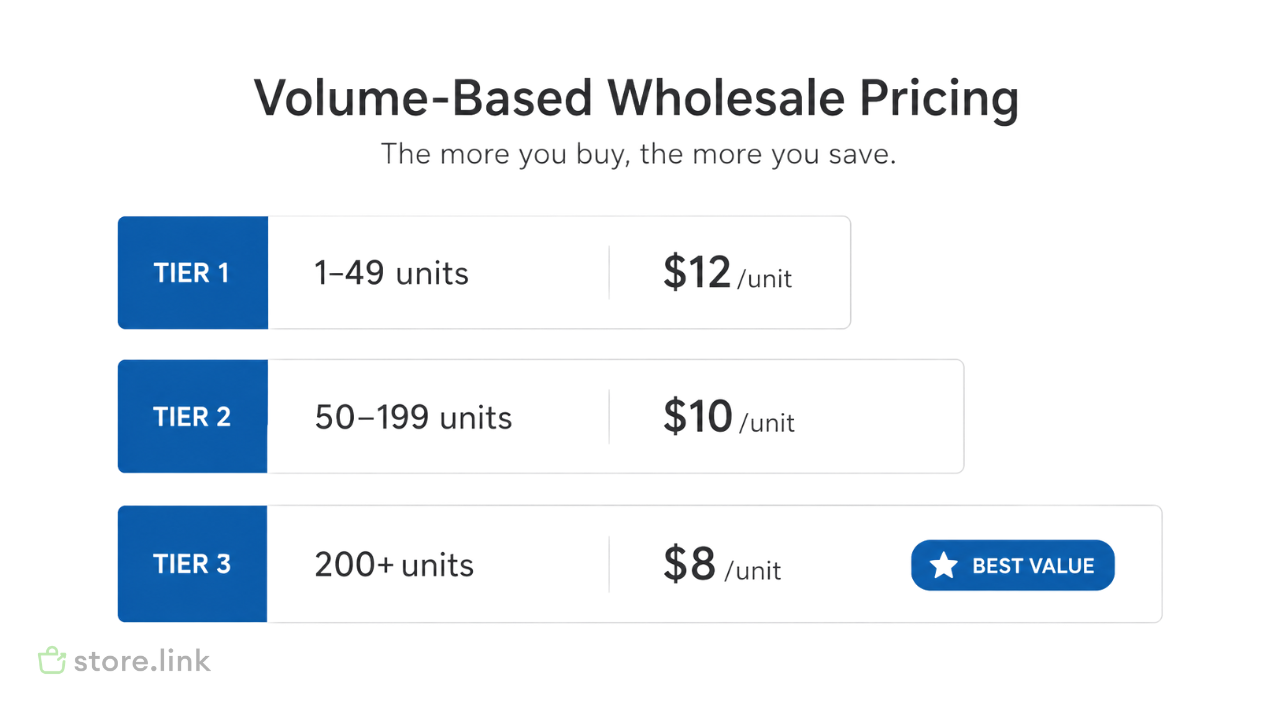
This rewards larger orders while protecting your margins at lower volumes. The buyer gets a better deal by committing more; you get predictable revenue.
One thing most wholesalers don't mention: price is rarely the only reason a business switches suppliers. Reliability, consistent quality, and good communication matter just as much. You can win on price and still lose the account if you miss a shipment.
Marketing a Wholesale Business: The Hard Truth
Honestly, this is the part nobody warns you about. Marketing a wholesale business is harder than marketing a retail one, and the playbook is completely different.
In B2C, you can run a Facebook ad and get sales the same day. In B2B wholesale, your sales cycle might take weeks or months. You're asking a business to change (or add) a supplier, which involves trust, approval processes, and budget decisions. That doesn't happen with a 30-second ad.
What does work in wholesale marketing? Direct outreach is still one of the most effective channels, especially in the early stages. Identify the businesses you want as customers, reach out personally (email, LinkedIn, even in-person visits for local markets), and lead with value. Don't pitch; start a conversation about their needs.
Trade shows and industry events are another powerful channel. Meeting buyers face-to-face, letting them touch and see your products, and handing over a line sheet still converts better than most digital channels in many industries.
Once you have a few customers, referrals become your best growth engine. B2B buyers talk to each other. One happy client at a regional boutique chain can open doors you couldn't knock on yourself.
Setting Up Your Online Wholesale Store the Right Way
Once your wholesale model is clear, the next step is bringing it online, but not in the same way a typical retail store would.
A wholesale ecommerce website needs to work differently because B2B buyers shop differently. They care less about browsing aesthetics and more about speed, clarity, bulk ordering, and pricing visibility.
Your wholesale store should support:
- bulk purchasing
- flexible quantity inputs
- minimum order quantities
- fast catalog browsing
- clean bulk ordering workflows
A business buyer reviewing your catalog doesn’t want to open dozens of individual product pages just to place an order. They want to view products quickly, enter quantities, understand pricing, and complete purchases efficiently.
That’s why many businesses now prefer wholesale ecommerce platforms built specifically for B2B ordering instead of traditional online store builders designed for retail shoppers.
With Store.link, you can create a wholesale-ready online store without dealing with complicated B2B ecommerce software or custom development.
The setup is simple. You describe what your business sells, choose your store name and currency, and Store.link automatically prepares the right store structure for your catalog. You can then manage products directly through Google Sheets, where one row represents one product.
During setup, you can enable Wholesale mode, which adds features designed for B2B selling, including minimum order quantities and bulk-friendly ordering flows.
Once your store is live, buyers can enter quantities directly from the catalog view, see updated totals instantly, and place bulk orders without unnecessary steps. Because your product rules are managed through Google Sheets, updating pricing, quantities, or minimum order requirements stays simple even as your catalog grows.
For businesses that want a fast and flexible wholesale ordering system without managing developers or complex ecommerce tools, this approach removes a lot of operational friction.
Before You Launch: A Quick Wholesale Readiness Checklist
Before going live, make sure you’ve covered the fundamentals:
- You’ve identified a niche with consistent reorder potential
- You’ve tested supplier reliability before committing to large inventory purchases
- Your pricing leaves healthy margins for both your business and your buyers
- You’ve defined minimum order quantities for each product
- You’ve prepared a direct outreach list of potential wholesale buyers
- Your wholesale website is optimized for bulk ordering workflows
- You have a plan for handling payment terms like net-30 or net-60 if needed
Final Thoughts
Starting an online wholesale business is not just about offering bulk discounts. It’s about understanding how business buyers think, what they expect from suppliers, and how easy you make it for them to place repeat orders.
The wholesalers that grow successfully are rarely just the cheapest. They’re usually the most reliable, organized, and easy to work with.
If you’re planning to launch a wholesale ecommerce store, start with a setup built for B2B buyers from the beginning. Store.link helps you create a wholesale-ready online store using Google Sheets, without the complexity of traditional wholesale ecommerce platforms.