


What is dropshipping? In short, it is a way to sell products online without ever buying or storing inventory yourself. You list products, a customer pays you, and a supplier ships the order straight to their door. In 2026, that simple model is bigger than ever and it no longer requires an expensive online store builder or a complex ecommerce website builder. With StoreLink, you can run a dropshipping store from a plain Google Sheet, for free.
This guide answers every beginner question in plain language: what dropshipping is, how it works step by step, whether it is legal, whether it is profitable, and whether it is actually worth starting in 2026.
Table of Contents
- What Is Dropshipping?
- What Is a Dropshipper?
- How Does Dropshipping Work Step by Step?
- Is Dropshipping Legal?
- Is Dropshipping Profitable?
- Dropshipping Pros and Cons
- How to Choose a Dropshipping Supplier
- Common Dropshipping Mistakes to Avoid
- Is Dropshipping Worth It in 2026?
- How StoreLink Makes Dropshipping Simpler
- Conclusion
- Frequently Asked Questions
What Is Dropshipping?
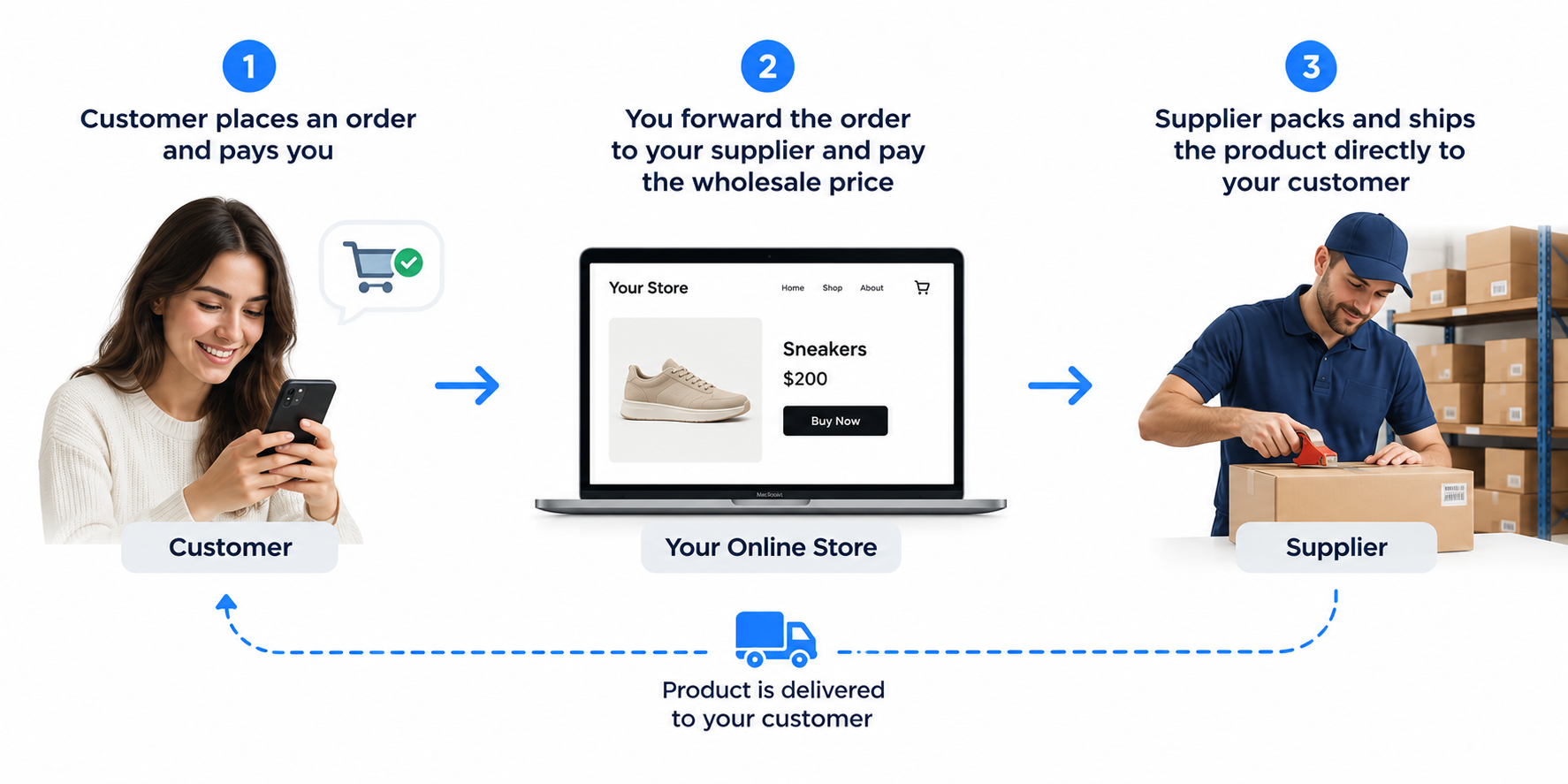
Dropshipping is a retail fulfillment method where the seller never handles the product. When a customer buys from your online store, you forward the order to a third-party supplier, manufacturer or wholesaler. That supplier packs the item and ships it directly to your customer.
You only pay the supplier after your customer has already paid you. That is the core difference from traditional retail, where you buy inventory first, store it, and hope it sells.
The model is growing fast. Grand View Research values the global dropshipping market at USD 464.4 billion in 2025, projected to reach USD 583.5 billion in 2026 and USD 2,180.8 billion by 2033 a 20.7% compound annual growth rate. Asia Pacific is the largest region, with a 36.0% revenue share in 2025, and fashion is the top-selling category at 37.4%.
What Is a Dropshipper?
A dropshipper is simply the person (or business) who runs the online store and coordinates the supplier. The dropshipper does three jobs:
- Chooses and lists products at a retail price they set.
- Markets the store and brings in customers.
- Forwards each order to the supplier, then handles customer service.
The supplier does the heavy lifting inventory, packing, and shipping. Think of the dropshipper as the storefront, and the supplier as the warehouse you never have to visit.
How Does Dropshipping Work Step by Step?
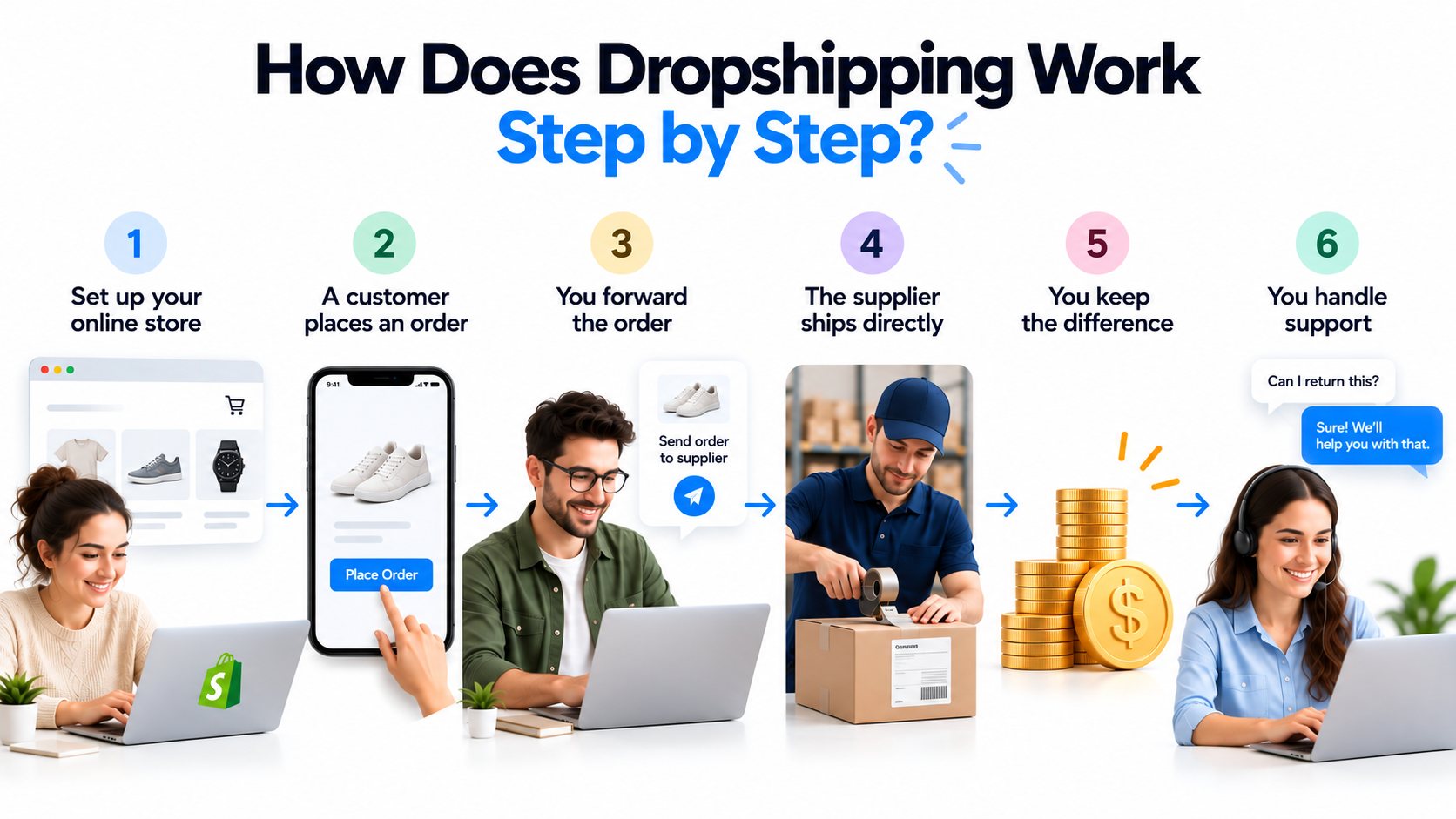
Here is the process, step by step:
- Set up your online store: You build a storefront and list products from a supplier's catalog, priced above the supplier's cost.
- A customer places an order: They pay you the retail price you set.
- You forward the order: You send the order details to your supplier and pay them their wholesale cost.
- The supplier ships directly: The product goes straight to your customer, usually with your store's branding or a plain packing slip.
- You keep the difference: Your profit is the gap between the retail price and the supplier's price, minus your marketing and platform costs.
- You handle support: Returns, refunds, and questions come to you even though you never touched the package.
The whole cycle runs on one principle: you never buy inventory up front. That is what makes the upfront cost so low compared to a traditional store.
Is Dropshipping Legal?
Yes, dropshipping itself is a completely legal business model. It is just a way of fulfilling orders, and it is used by businesses of all sizes around the world.
What matters is how you run it. To stay on the right side of the law, you must:
- Sell genuine products: Reselling counterfeit or trademark-infringing goods is illegal, no matter the model.
- Follow consumer protection laws: Be honest in your product descriptions, honor refunds, and don't run misleading ads.
- Collect sales tax: where your country or state requires it.
- Respect platform policies; Marketplaces like Amazon have their own dropshipping rules for example, Amazon generally does not allow you to buy from another online retailer and have them ship to your Amazon customer.
The short answer: dropshipping is legal, but your store still has to follow the same laws and rules as any other business.
Is Dropshipping Profitable?
Dropshipping can be profitable, but the margins are thinner than they look. Because the barrier to entry is low, competition is high and your profit only comes from the gap between retail and wholesale price.
Shopify estimates dropshipping will generate more than $476 billion in ecommerce sales in 2026. Typical dropshipping profit margins run roughly 15–20% on well-chosen products. That means a $40 sale might leave you around 6–8 after paying the supplier and your marketing costs.
Those costs are not small, and beginners routinely forget them:
- Payment-processing fees on every transaction.
- Shipping costs, whenever you absorb them rather than charge the customer.
- Refunds and chargebacks, which cost you the product and often the shipping too.
- Taxes on your profit and, depending on your location, on the sale itself.
- Currency conversion, if your supplier invoices in a different currency than you sell in.
- Tools and subscriptions, from your store platform to any research or ad software.
This is where the platform choice matters. Many platforms take a 2–5% cut of every sale on top of a monthly fee. StoreLink charges 0% commission, so the sale price your customer pays is yours to work with; only your supplier and your marketing sit between you and your profit.
A quick example. You list a product for $50. Your supplier charges $30, so your gross margin is $20. Out of that, you might spend $8 on ads to win the customer, leaving roughly $12 in profit per sale. On 100 orders a month, that is about $1,200 before platform fees. If your platform takes 5%, you lose another $250 a month on those sales. At 0% commission, that $250 stays in your pocket.
Dropshipping Pros and Cons
No business model is perfect. Here is the honest picture, with enough detail to help you decide whether the trade-offs fit how you want to work.
The pros of dropshipping:
- Low startup cost: You don't buy inventory, rent a warehouse, or pay for packing staff. The main upfront costs are your store (free with StoreLink) and your marketing. That is why dropshipping is one of the cheapest ways to test an online business idea.
- Easy to test products: If a product doesn't sell, you remove it from your sheet and try another no clearance sale, no dead stock, no money stuck in unsold inventory.
- Location freedom: Your store lives in a Google Sheet and a browser. As long as you have an internet connection, you can run the business from home, a coffee shop, or another country.
- No shipping or fulfillment work: The supplier packs and delivers every order. You never print a label, wait in a post office queue, or manage a return shelf.
- Wide product range: Because you don't pre-buy anything, you can list a broad catalog of hundreds of products without spending a rupee on stock first.
- Simple to scale: Adding 100 new products costs you no extra warehouse space. Your costs stay mostly flat as your catalog grows.
The cons of dropshipping:
- Thin margin: Because the barrier to entry is low, competition is high, and customers can compare prices in seconds. Most dropshippers work with 15–20% margins, so every dollar of ad spend matters.
- Less quality control: You don't see or touch the product before the customer does. A damaged item or a colour that differs from the photos becomes your problem, not the supplier's; in the customer's eyes, you sold it.
- Shipping delays are out of your hands: When a supplier is slow, you can't speed them up. Long delivery windows are the fastest way to collect refund requests and one-star reviews.
- Customer service burden: Returns, refunds, and "where is my order?" emails all land on you. A dropshipping business still needs real customer support.
- Supplier dependence: If your supplier runs out of stock, raises prices, or disappears overnight, your store feels it instantly. Choosing and monitoring suppliers carefully is half the job.
- Harder to differentiate: When many stores sell the same supplier's products, you compete on niche, branding, trust, and marketing, not on having a unique product nobody else can stock.
How to Choose a Dropshipping Supplier
Your supplier decides your product quality, shipping speed, and refund experience so choose carefully.
- Order a sample first: Test the product quality and packaging before you sell it to anyone.
- Check shipping times: Long delivery windows (3–4 weeks) create refunds and bad reviews. Prefer suppliers with faster, tracked shipping.
- Compare pricing: Get quotes from a few suppliers for the same product the cheapest is rarely the best.
- Ask about returns: Know who handles returns and how refunds work before a problem arises.
- Look for reliable communication: A supplier who answers quickly now will answer quickly when a customer complaint lands on you.
Marketplaces like AliExpress and dedicated supplier directories are common starting points. Whatever you choose, keep everything in writing.
How to Start Dropshipping in 2026
Here is the practical sequence, from idea to first order.
1. Choose a narrow niche. Pick a specific audience and a specific problem rather than a general store. A narrow niche makes your ads cheaper to target, your listings easier to write, and your store easier to remember.
2. Research suppliers before you commit to products. Availability, shipping speed, and pricing all constrain what you can realistically sell. Shortlist two or three suppliers per product so you are not exposed to a single point of failure.
3.Order samples. Buy the product yourself, from the supplier you plan to use, shipped to your own address. This tells you the real delivery time, the real packaging, and the real quality. Skipping this step is the most expensive shortcut in dropshipping.
4. Calculate full unit economics. For each product, write down the supplier cost, shipping, payment-processing fee, expected refund rate, taxes, and your target ad cost per sale. If what remains is not worth your time, the product is not viable no matter how good the ads are.
5. Create your store. Set up your storefront, write honest product descriptions, and use real photos where you can. This is the step that used to require a developer and now does not.
6. Add your policies and realistic delivery estimates. Publish shipping times, a returns policy, and contact details before you take a single order. Quoting a delivery window you cannot meet is the fastest route to chargebacks.
7. Launch with a small test. Run a limited budget against one or two products before scaling anything. You are buying information at this stage, not sales.
8. Forward orders and monitor fulfillment. Send each order to your supplier promptly, track it, and follow up on anything that stalls. This is ongoing manual work in most setups, so build the habit early.
Common Dropshipping Mistakes to Avoid
Most dropshipping failures come from a handful of avoidable mistakes:
- Selling everything: A store that sells dog toys and phone cases appeals to no one. Pick a niche.
- Ignoring shipping times: Slow delivery is the number one source of bad reviews.
- Not testing the product: Never sell something you have not at least ordered a sample of.
- Underpricing: Competing only on price kills your margin. Compete on niche, packaging, and trust instead.
- Neglecting customer service: Refunds and questions still land on you answer fast.
- Giving up too early: Dropshipping takes testing and patience. Most profitable stores took months to find a winning product.
Avoid these six, and you are already ahead of most beginners.
Is Dropshipping Worth It in 2026?
For the right person, yes, dropshipping is worth it. It remains one of the fastest ways to test a product idea and start selling online without much money.
It is not a get-rich-quick scheme. The people who succeed treat it like a real business: they pick a niche, research suppliers, write honest listings, and market consistently. The people who fail usually expect passive income from day one.
The good news is that the technical side has never been easier. You no longer need a developer or a big budget to launch. A free store builder that runs on Google Sheets gets you live in minutes, so your energy goes into selling, not setup.
How StoreLink Makes Dropshipping Simpler
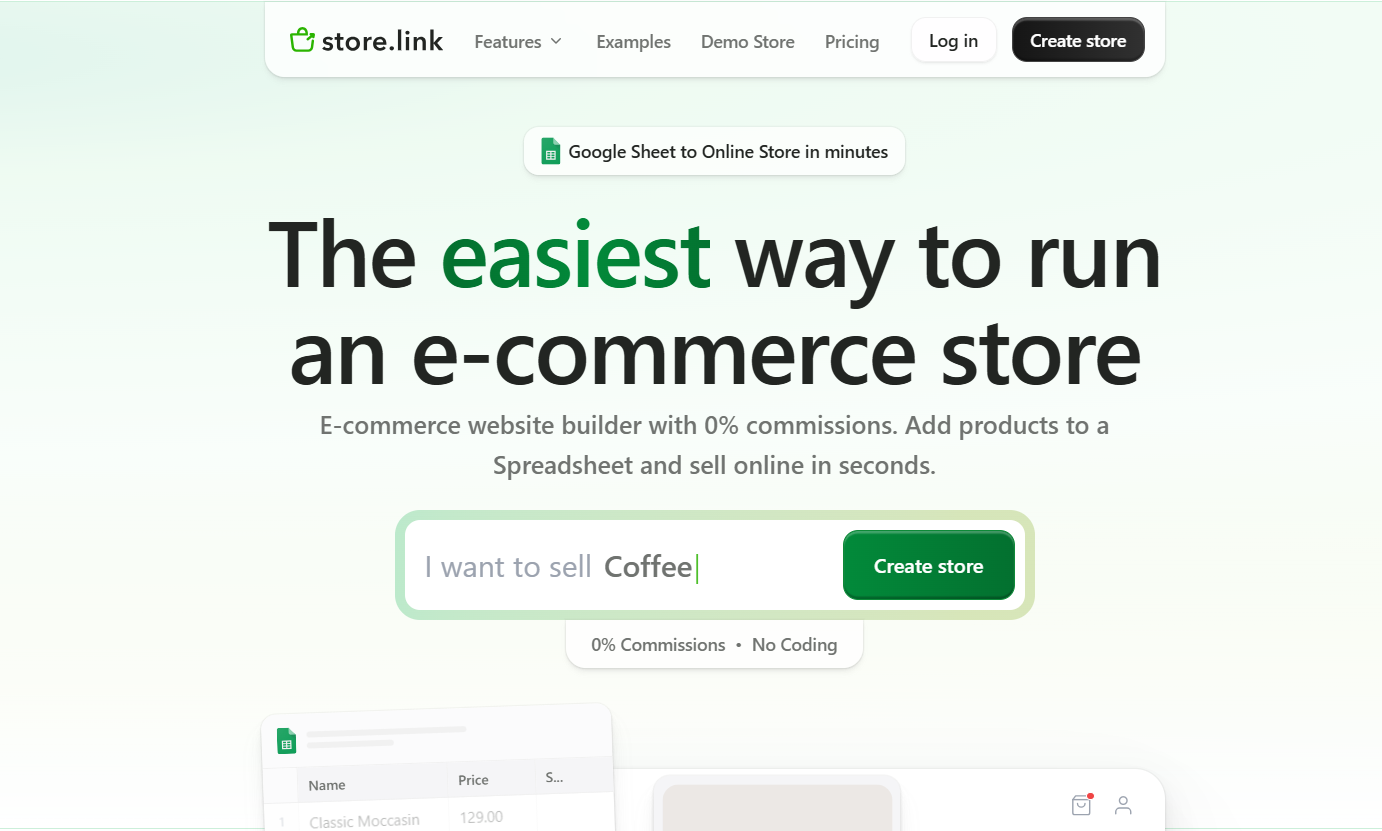
StoreLink is built for exactly this kind of lean, low-overhead selling and it is free to start.
The standout feature: StoreLink is built on top of Google Sheets. You don't learn a complicated admin panel. You manage your products directly in a spreadsheet one row equals one product. Change a price or a stock level in the sheet, and your store updates automatically in real time.
Here is how a dropshipper uses it:
- Describe what you sell. StoreLink generates a storefront with a theme matched to your product category, plus sample products to show you the layout. You can customize all of it afterward.
- Add your products in Google Sheets. Each row becomes a product page. You maintain your supplier’s catalog in the sheet yourself and update it as their prices and stock change. There is no limit on how many products you list, even on the free plan, which matters when you are testing a wide catalog.
- Connect payments and shipping. The free plan supports Stripe, PayPal, Razorpay, Square, and custom payment links, along with a shipping method. Multiple shipping methods start on paid plans.
- Share your store. A free store gets a URL in the format yourname1234.store.link. Paid plans let you pick your own subdomain, and connect a custom domain from the Standard plan up.
Why it fits dropshipping perfectly:
- Zero commission on every sale, on every plan, including the free one. Payment-gateway fees still apply, as they do everywhere.
- Unlimited products on the free plan. Listing a hundred products from your supplier’s catalog costs the same as listing five.
- The free plan lets you view and manage 50 orders per month. Customers can keep ordering past that, but excess orders are hidden. They do not reach your dashboard or your Order Sheet, and they trigger no email or WhatsApp notification. StoreLink emails you when you hit the limit, and upgrading makes the hidden orders visible in the dashboard, though they are not added back to your Google Sheet. You export them from the dashboard instead.
- Orders reach you by WhatsApp, email, or straight into a Google Sheet. That last option suits dropshipping, since a running order sheet is easy to filter and forward to a supplier by hand.
- No coding and no monthly fee to get started.
- More than 15,000 stores have been created with StoreLink.
If you want to test the dropshipping model without paying monthly fees while you learn, StoreLink's free online store builder is the place to start. You can even browse the demo store to see what a finished storefront looks like.
Conclusion
Dropshipping in 2026 is a proven, low-cost way to start selling online as long as you go in with clear eyes. The model removes the biggest barrier of traditional retail (buying inventory before you know it will sell), but it does not remove the work of running a business. Thin margins, shipping you can't control, and customer service that lands on you are real and they are manageable if you treat the store like a business, not a lottery ticket. If you are starting out, the smartest move is to keep your costs at zero while you learn. Test one niche, order a sample from your supplier, write honest listings, and market consistently. You don't need a big budget, a developer, or an expensive platform to do any of that.
That is exactly what StoreLink is built for. It turns a Google Sheet into a working online store in minutes, charges 0% commission on every sale, and lets you start free so your early mistakes cost you time, not money. When you are ready, build your first dropshipping store free on StoreLink, manage your products from a spreadsheet, and keep 100% of what you sell.
Frequently Asked Questions
What is dropshipping?
Dropshipping is a way to sell products online without buying or storing inventory. You list products, a customer pays you, and a third-party supplier ships the item directly to the customer. You keep the difference between your retail price and the supplier's wholesale price.
How much money do I need to start dropshipping?
You can realistically start with a few hundred dollars. The essentials are your store (free with StoreLink), a domain (optional, since StoreLink gives you a free subdomain), and a marketing budget. The biggest variable is advertising some sellers start with 100–300 in ad spend and reinvest profits as they grow.
Can I start dropshipping with no money?
Almost. You can build a free store and list free products without spending anything on setup. You will still need some money to market your store ads, content, or time because customers won't find an unadvertised store on their own. The only truly zero-cost way is to promote through free channels like social media, which costs time instead of money.
Do I need an LLC to start dropshipping?
No, you don't need an LLC to start. You can begin as a sole proprietor and test the model first. As your sales grow, forming an LLC (or the equivalent in your country) is worth considering it protects your personal assets and can make tax and banking simpler. Check your local regulations, since requirements vary by country and state.
How does dropshipping work with Google Sheets?
Your supplier’s catalog goes into a spreadsheet, one product per row, with columns for the name, price, image, and stock. StoreLink turns that sheet into a live storefront, so updating a price or marking something out of stock is a single cell edit rather than a trip through an admin panel. You keep the sheet current yourself, since it does not pull from your supplier automatically.