


Starting an ecommerce business in 2026 is more realistic than ever. You no longer need a big budget, a warehouse full of products, or a complicated tech stack to get started. With the right niche, a simple store setup, and the right ecommerce website builder, even a first-time founder can start selling online.
Modern online store builder platforms make it easy to create a professional store, manage products, and accept payments without technical expertise. This guide walks you through every step, from choosing a niche to making your first sale. No technical background needed. No big budget required.
Table of Contents
- Why Ecommerce Is Growing in 2026
- How Does an Ecommerce Business Work?
- Types of Ecommerce Businesses
- Step-by-Step Guide: How to Start an Ecommerce Business
- How to Choose the Right Products to Sell
- Why Store.link Is a Smart Choice for Beginners
- How Much Does It Cost to Start an Ecommerce Business?
- Benefits of Running an Ecommerce Business
- Marketing Strategies for Ecommerce Success
- Common Mistakes That Kill New Online Stores
- Future Trends in Ecommerce
- Conclusion
- FAQs
Why Ecommerce Is Growing in 2026
Online shopping has become the default for millions of consumers worldwide. According to Statista, global ecommerce sales are projected to surpass $8 trillion by 2027, driven by a consistent shift in how people discover and buy products.
Consumers now find products on social media, compare prices instantly, and complete purchases on their phones in minutes. Several factors are driving this growth:
- Smartphone penetration: most purchases now begin on a mobile device
- Faster internet access: connectivity is improving rapidly, even in emerging markets
- Secure digital payments: consumers trust online transactions more than ever
- Social commerce: Instagram, TikTok, and Pinterest have made in-app shopping seamless
- Lower startup costs: launching an online store costs far less than opening a physical shop
For entrepreneurs, the window to build a sustainable ecommerce business is wide open. The barrier to entry has never been lower.
How Does an Ecommerce Business Work?
An ecommerce business sells products or services through a digital storefront instead of a physical shop. Here is how a typical transaction flows:
- A customer visits your store and browses your products
- They add an item to their cart and proceed to checkout
- Payment is processed securely through a payment gateway
- You receive an order notification and prepare the item for delivery
- A logistics partner ships the product to the customer's door
- Post-purchase, you handle support, returns, or follow-ups
Modern platforms automate most of this. Inventory tracking, order management, payment processing, and customer notifications can all run with minimal manual effort once set up. For a first-time seller, that means you can focus on finding customers rather than managing operations.
Types of Ecommerce Businesses
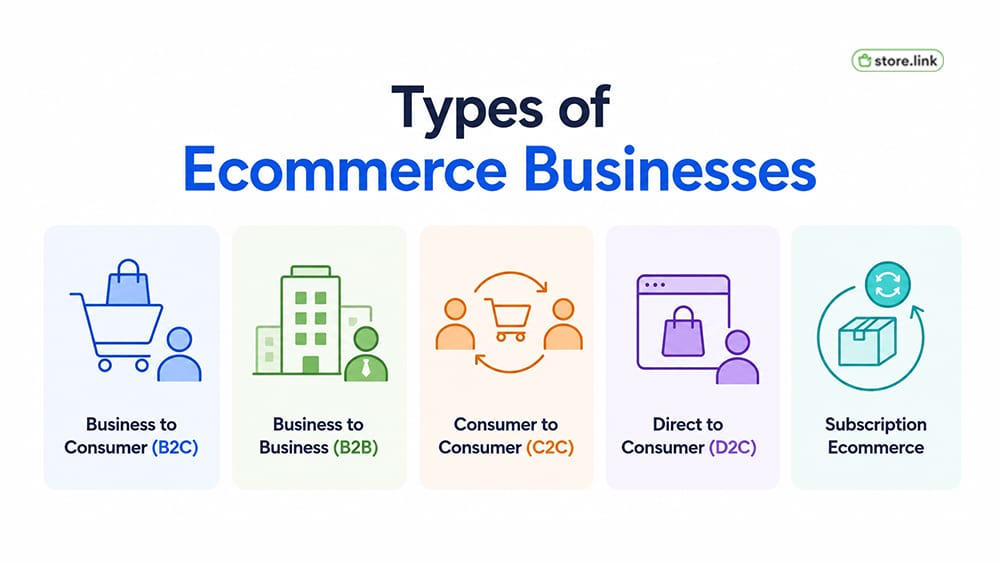
Before you start building, it helps to understand which model fits what you want to sell and who you want to sell it to.
- Business to Consumer (B2C) is the most common model you sell directly to individual shoppers. Think online clothing stores, beauty brands, or electronics retailers.
- Business to Business (B2B) means selling products or services to other businesses. Orders tend to be larger and relationships longer-term.
- Consumer to Consumer (C2C) allows individuals to sell to other individuals through a marketplace platform, like resale or peer-to-peer selling sites.
- Direct to Consumer (D2C) brands sell directly to customers without relying on wholesalers or retailers, giving full control over pricing, branding, and the customer experience.
- Subscription Ecommerce is based on recurring payments. Customers receive products or services weekly, monthly, or yearly. This model creates predictable revenue and long-term customer loyalty.
Step-by-Step Guide: How to Start an Ecommerce Business
Step 1: Choose Your Niche
Your niche is the product category or market you want to serve. A focused niche is easier to market than a general store, especially when starting out.
Look for a niche with clear customer demand, good profit potential, manageable competition, and ideally some personal interest or knowledge. Popular categories in 2026 include eco-friendly products, digital downloads, health and wellness, home décor, and fashion accessories.
Step 2: Research Your Target Audience
Before you list a single product, understand who you are selling to. Find out what age group they belong to, where they spend time online, what problems they are trying to solve, and how much they typically spend on similar products.
Google Trends, Reddit communities, and competitor reviews are useful places to start. The better you understand your audience, the easier it becomes to write product descriptions, run ads, and create offers that convert.
Step 3: Validate Your Product Idea
Do not build a full store before checking whether people actually want what you plan to sell. Check keyword search volume, read reviews in your niche, look at what competitors are selling, and consider listing a few products before expanding. This reduces risk and gives you better direction early.
Step 4: Write a Simple Business Plan
You do not need a lengthy document, but you do need clarity on your startup budget, how you will source products, your pricing strategy, which marketing channels you will use, and rough revenue goals for the first three to six months.
Step 5: Choose an Ecommerce Platform
Your platform is your storefront. A good one should offer easy product management, mobile-friendly design, built-in payment processing, SEO-friendly structure, and minimal technical setup. For beginners, simplicity matters more than having every advanced feature on day one.
👉 Start your online store easily with store.link– simple for beginners
Step 6: Set Up Your Store and Add Products
Once your platform is live, set up your store name, branding, product categories, shipping policy, and payment methods. When adding products, write descriptions that answer real buyer questions, include high-quality images, and clearly show pricing and shipping details. Good copy makes a real difference in conversions.
Step 7: Launch and Start Marketing
Once the store is live, focus on getting traffic and learning what works. Start with a few channels instead of trying everything at once. SEO, short-form content, email capture, and one or two social platforms are solid starting points for most new stores.
How to Choose the Right Products to Sell
Product selection plays a major role in ecommerce success. Even a well-designed store will struggle if the product is weak.
Good ecommerce products solve a real problem, have consistent year-round demand, offer healthy profit margins after shipping and fees, and are straightforward to ship or deliver. Use tools like Google Keyword Planner or Ubersuggest to identify what people are actively searching for. Rising search volume around a product is a strong signal that demand is growing.
Avoid saturated niches where large brands dominate search results unless you have a clear angle or serve a specific audience they are not reaching. Writing strong ecommerce product page SEO from the start will also give you an edge as your store grows.
Why Store.link Is a Smart Choice for Beginners
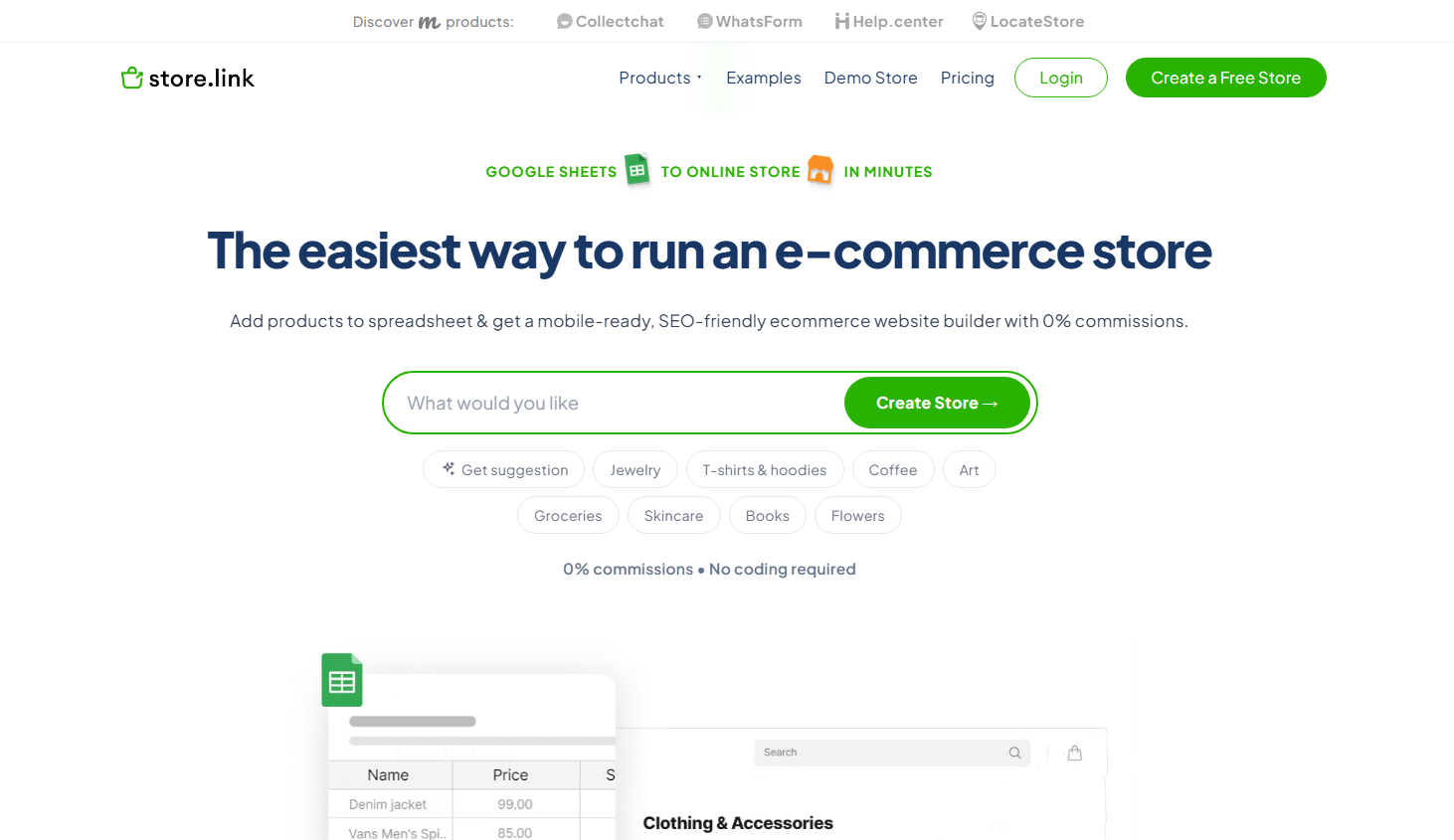
Store.link is a free ecommerce website builder built on top of Google Sheets. Instead of learning a complicated backend, you manage products and inventory in a spreadsheet you already know how to use, and your store updates automatically in real time.
When you create a store, you get a store.link subdomain automatically no domain purchase needed to start selling. On the Lite plan and above, you can set a clean branded URL using your exact business name. On the Standard plan and above, you can connect your own custom domain. So wherever you are starting, there is a domain option that fits.
What makes it especially useful for beginners is the combination of simplicity and zero cost. The free plan includes unlimited products, automatic Google Sheets sync, order management, and payment gateway integrations with Stripe, PayPal, Razorpay, and Square. It supports up to 50 orders per month more than enough to validate a product idea before spending anything on a platform.
Across all plans, Store.link charges zero commission on sales. Every rupee or dollar you earn goes directly to you. Most other platforms quietly take 2 to 5 percent per transaction, which adds up quickly.
The stores are also SEO-friendly out of the box. Your product pages and category pages are built to perform well in search engines without needing plugins or technical configuration. Whether you are selling digital products or physical goods, the setup process is simple just share what you sell and your store details, and your store will be ready in seconds, matched to your business.
How Much Does It Cost to Start an Ecommerce Business?
Startup costs vary depending on your business model and platform. Here is a realistic breakdown:
With Store.link, you can get a professional store live at zero platform cost and zero commission. Dropshipping and print-on-demand models can further reduce inventory risk since you only pay for a product after a customer has already ordered it.
👉 View Store.link Pricing Plans
Benefits of Running an Ecommerce Business
Ecommerce offers several structural advantages over traditional retail.
You avoid the costs of renting a physical space, which keeps overhead low and gives more of your revenue back to the business. Your store is accessible to customers anywhere in the world, not just in your city. It runs 24/7, so sales can happen while you sleep. Adding new products or reaching new markets does not require opening a new location. And analytics tools give you real insight into what customers are buying and why, so you can improve faster over time.
Marketing Strategies for Ecommerce Success
A great store with no visibility will not make sales. Growth comes from consistent distribution across the right channels.
SEO: helps your store appear in search results when people look for products online. Focus on keyword-rich product pages, helpful blog content, and a clear site structure. This drives free, compounding traffic over time and is one of the most valuable long-term investments for any ecommerce business.
Social media: works well for visual products. Instagram and Pinterest are good for discovery. TikTok reaches younger audiences effectively. Pick one or two platforms where your target audience already spends time and build consistency before expanding.
Email marketing: is one of the best channels for repeat purchases. A welcome email with a small discount, followed by regular product updates and useful content, keeps customers coming back. Tools like Klaviyo or Mailchimp are manageable even as a solo founder.
Influencer marketing: can build trust quickly. Micro-influencers with 10,000 to 50,000 engaged followers often outperform larger creators when their audience closely matches your product.
Paid advertising: through Google Ads captures buyers actively searching for your product, while Meta ads help with visual discovery and retargeting. Start small, measure results, and scale only what generates profitable returns. Successful ecommerce marketing is not about using every channel at once. It is about finding the channels that work best for your audience and consistently improving your efforts over time.
Common Mistakes that Kill New Online Stores
Plenty of web retailers fail due to common yet mistakes.
Common errors are:
- Opting for oversaturated niches
- Ignoring mobile optimization
- Poor customer support
- Weak product descriptions
- Inconsistent branding
Avoiding these common traps early on is the fastest way to protect your margins and build long-term profitability.
Future Trends in Ecommerce
The ecommerce industry is transforming swiftly.
Important trends in 2026 are:
- AI-powered shopping experiences
- Voice search optimization
- Faster delivery systems
- Personalized recommendations
- Social commerce growth
Businesses that align early with these developments will persist as competitive.
More read: E-Commerce Trends: The Future of Online Shopping
Conclusion
Right now, the online shopping world is scaling up fast, consequently investigating ecommerce makes sense. Picking good items helps, especially when paired with smart promotion and a solid website setup. Success online? It's possible by 2026, even for beginners. A strong foundation matters more than luck.
Starting out has never been easier thanks to tools such as Store.link, which run on basic spreadsheets yet open doors globally at low cost. Because it works through Google Sheets, anyone anywhere can set up shop without complex setups. For those just learning the ropes or veterans looking to scale, launching online now might lead to steady earnings later. Growth does not always require big budgets, sometimes it begins with something small but smart so that longevity often comes from simple systems that stay reliable over time.
FAQs
How can I start an ecommerce business?
Start with picking a niche, then dig into who might buy what you offer. Once clear on customers, move toward selecting items they’d actually want. A website comes next, build it so people find their way easily. Getting noticed happens when sharing through platforms like Instagram or Google shows up naturally.
How profitable is ecommerce?
Profit swings wide in online selling, depending on smart product picks, tight control over spending, plus how well promotions are handled. Some digital stores pull off solid gains while keeping day-to-day costs quite lean.
Which is the best e-commerce website builder?
Depending on what a business requires, the right tool can differ as it is built into Google Sheets, Store.link works well for those just starting out, simple to handle, free to access, yet designed with newcomers in mind.
Why is an ecommerce store important?
Running a shop online lets companies connect with extra buyers. Always open, unlike regular shops that close at night. Costs less to run than leasing a building on Main Street, as their growth tends to speed up when selling through digital storefronts.